FIVE SAMPLES FOR YOUR REVIEW
THE HARD TRUTHS
Each truth in the book is paired with an original visual intrepretation by artist Valheria Rocha.
Use these truths and compelling art to discover how you can change your behavior, build new skills, and become more fulfilled.
Thrive, not just survive.

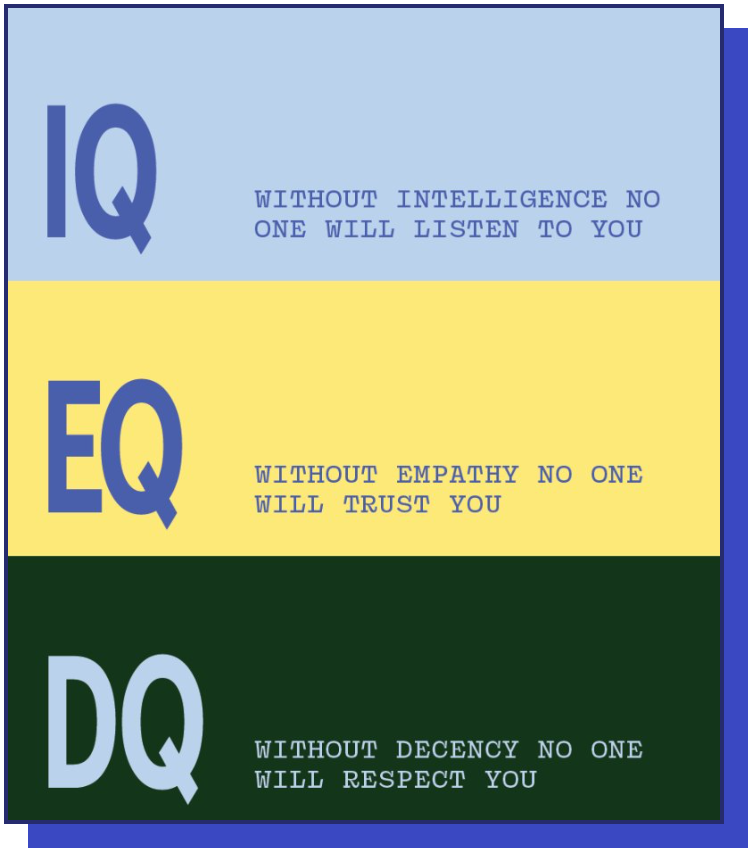
SUCCESS REQUIRES THREE THINGS.
IQ plus EQ plus DQ.
IQ doesn't mean that you need to be the smartest person in the room. It does mean that you need to know something so well that people turn to you when they have questions about a product, an analysis, a customer, or a vendor. You need to pay attention to the details to support the other people around you.
EQ is all about putting others ahead of yourself. Understanding how others think, feel, and behave immediately gives you credibility because work is about serving others. The closer you are to meeting the needs of the people you serve, the more valuable you'll be to your organization.
DQ is something that is often in short supply these days. Being decent means speaking, acting, and behaving with respect, being mannerly, and focusing on the dignity of others. When your primary purpose is money, attention, adulation, or any derivation of these narcissistic characteristics, then by definition you lack decency.
Here's the twist. When you finished school and joined the workforce, you probably believed you already had a high IQ, EQ, and DQ.
But at work, you probably have a pretty low IQ because you don't yet know the intricate details about your organization's products and services.
Your EQ will also be very low until you deeply understand the problems of the people you serve. The good news is that your DQ can be high on day one.
Be patient. In time, your success is assured.
1 + 1 + 1 = 10.
(Maybe not today, but soon.)

CONTRIBUTION DETERMINES COMPENSATION
You give to get.
One young graduate from Amherst shared with me that their ideal job was a remote job where they could continue to live their life as they wanted. This meant long walks on a sunny day, extensive travel, and plenty of time to paint and play music.
I asked them to name some jobs that allow you to do that because I’d like one too. Unfortunately, the nature of work is that you exchange your time, attention, and skill for compensation. No one gets paid for potential. You are paid for value created, problems solved, or risk mitigated, not for how talented you might be.
Work will expand to the parameters you set. If you are working 60–80 hours per week, then you should be highly compensated. If you are working that much and you have no control over when the work must be done (like staying up until 4 a.m.) or you can’t plan a weekend dinner with your significant other, then the exchange isn’t fair and reasonable.
Only you can decide what is a fair exchange. I once worked in a well-compensated job with good benefits, but I had to travel 40–45 weeks of the year. I used to joke that I didn’t live in Atlanta; I lived at Hartsfield-Jackson International Airport.
For a time, this was a good trade for me—until it wasn’t. The beauty of most economies is that you have the freedom to choose your occupation, start your own business, or change jobs to optimize the trade of your time, attention, and skill.
Make a trade that works for you.
EVERY DECISION IS EMOTIONAL.
Lead with the heart.
Whenever I teach at a university or speak at a conference, I’m always asked, “How do I get people to support my idea?”
I ask them what they are doing now. Startup entrepreneurs talk about market size, potential revenue, and product features. A new wine spritzer has a huge market if they can just get one percent. A financial education tool enables millions saved from smarter decisions. Internet-connected HVAC offers convenience of control.
Their fatal mistake? They make a purely rational pitch when people buy based on emotion.
It doesn’t matter whether you are buying clothing, electronics, food, cars, or even medical services. It all comes down to emotions. People imagine how they are going to feel using or experiencing what you offer. You are selling hope. That’s a purely emotional pitch.
Make sure you weave emotional threads throughout your pitch. Use visceral descriptions of children looking for clean water to drink, the elderly struggling to breathe, or mothers worried about their teenage sons. Think of all the people impacted in these situations.
Remember the goal is to get people to invest their time, money, and interest in your idea. Start with emotion. Close with emotion.
The mind always follows.

OBJECTIONS ARE MOLEHILLS.
They aren't mountains.
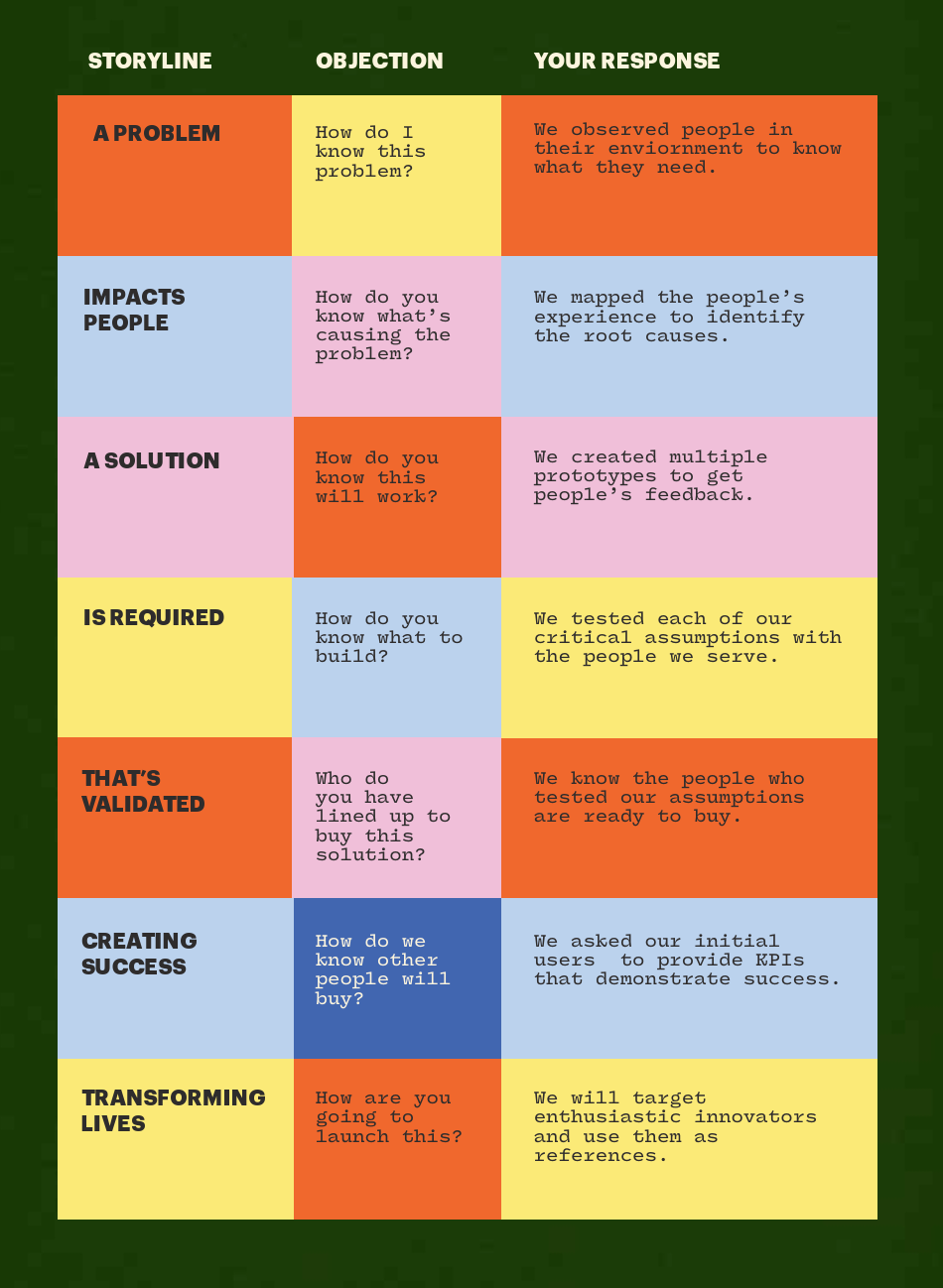
There are seven objections that come up whenever a new idea is presented. They are as consistent and predictable as the sun rising in the morning.
The good news is that they follow a simple storyline framework:
You can even preemptively defeat the devil’s advocate by addressing each objection as you present your idea. For example, “Some people may wonder how we know this is a problem. Well, we observed people in their environment to see what they needed.”
Now, transition to the next story element. “We were shocked to discover a, b, and c which caused x, y, and z. This enabled us to identify the root causes of the problem.” Then, introduce your solution. “This insight helped us build our prototypes before getting several rounds of feedback.”
Keep working your way through this list of objections until you feel you can handle every objection.
You shall overcome.
EARLY CAREER CHOICES DON’T MATTER MUCH.
Start anywhere.
Many young people struggle figuring out what they want to do. There’s worry about which path to choose, fear about making the “wrong” choice, and dread that you won’t be able to pivot to a different job function or industry.
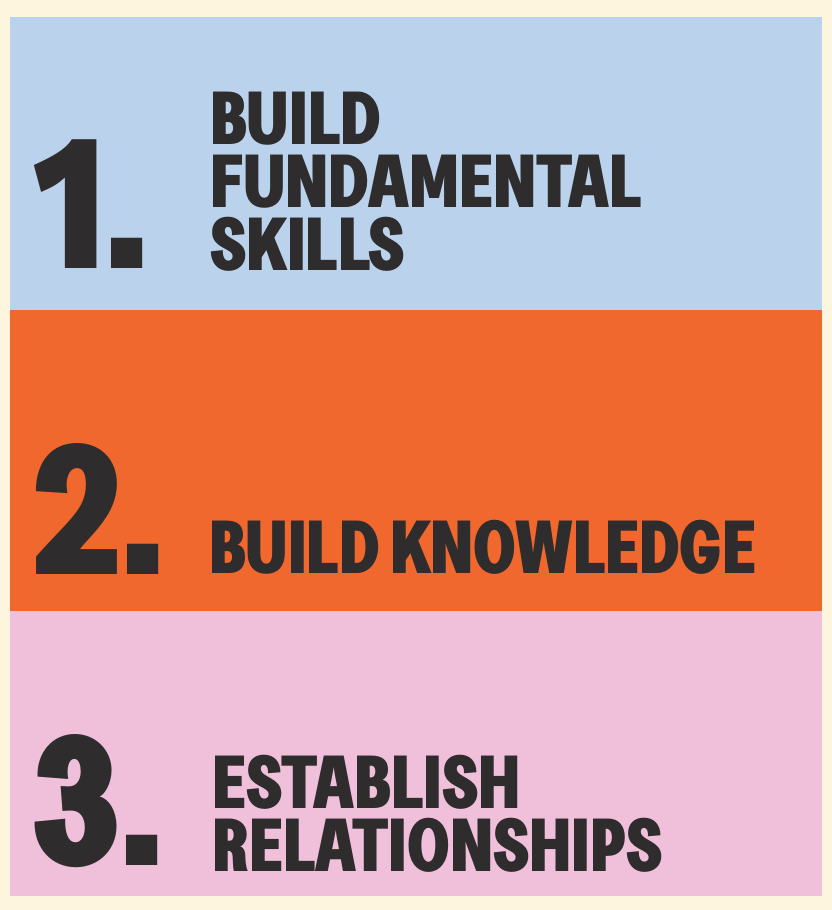
In reality, what you do when you start out doesn’t matter much. What does matter is understanding everyone goes through three distinct phases of personal development. Each phase will last three to four years and requires a distinctly different mindset.
The first phase is when you are building fundamental technical, collaboration, and execution skills. You may have been exposed to or practiced some of these skills in school, but now is the time for you to master them. This is usually “grunt work.” It is the stuff entry-level people must go through to establish their core credentials for future work.
The next phase is more intellectual. It is focused on building knowledge. This is the time when you learn how the pieces of the work puzzle fit together and how to create value for people. Your understanding will enable you to advance within your existing organization or switch jobs to work for someone who prizes your skills and knowledge of practices that work well.
The third phase is when you establish relationships. It’s the ideal time for a customer facing job where you are consistently delivering solutions to difficult problems. This problem-solving capability significantly increases your economic value and expands your career options.
This progression works whether you stay in a single industry or jump around. I worked in advertising, real estate, consumer packaged goods, software, consulting, health care, and financial services—in big companies and startups.
The path is rarely straight.